
Men’s Health Week 2026: If the Fish Are Dying, Look at the Water
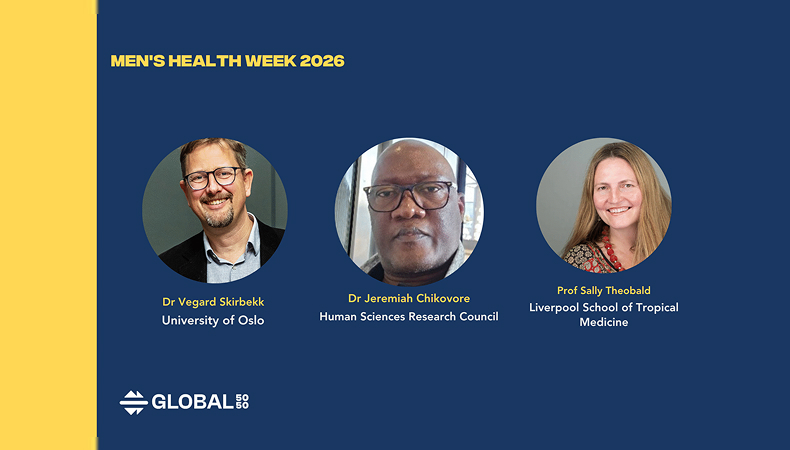
Prof. Sally Theobald, Liverpool School of Tropical Medicine
Dr. Jeremiah Chikovore, Chief Research Specialist, Human Sciences Research Council, South Africa
Dr. Vegard Skirbekk, University of Oslo
Three experts on what public health keeps getting wrong about men’s health and what it would take to get it right
Men’s Health Week usually makes room for awareness and reflection. But it rarely makes room for the harder question: why, after all this time, are the gaps still so wide?
For nearly a decade, Global 50/50 has built its work around a single truth that gender shapes health outcomes for everyone. Not just women, not just in clinics, but across the whole of societies.
Blaming the fish
At a men’s health conference last year, the campaign group Movember offered a metaphor that Sally Theobald has not forgotten. If all the fish in a pond were dying too young, we wouldn’t blame the fish — we’d look at what’s wrong with the water. Theobald, a health systems researcher at the Liverpool School of Tropical Medicine, invokes it to describe where the field keeps going astray:
“If we see men’s health outcomes mainly because of poor choices, we will keep investing in awareness campaigns and behaviour change messaging,” she says. “If we understand them as shaped by gendered social, commercial and structural determinants, then the focus shifts towards systems and reducing social and economic disadvantage.”
Men die earlier than women in almost every country in the world. Yet as Jeremiah Chikovore, a sociologist at the Human Sciences Research Council in South Africa, points out, the field that produced all that mortality data has invested remarkably little in understanding what drives it.
“The health field historically applied a gendered lens only to women, largely through reproductive health,” he says. “Men were treated as the ‘default body’, and hence their specific vulnerabilities were not problematised. Knowledge about male physiology was produced, but not about the social experience of being a man and what that does to health.”
The costs have been measurable. Male depression gets coded as a behavioural problem. Occupational injury gets filed under labour policy. Male suicide sits in an epidemiological category of its own, rarely interrogated as a gendered phenomenon with gendered causes and gendered solutions. And funding has followed: research on prostate cancer, suicide, and occupational disease operates, as Chikovore puts it, with researchers “in relative isolation from one another” and without the sustained advocacy infrastructure that has, rightly, driven progress in women’s health.
The gap is not biological fate
The male-female life expectancy gap may be visible in nearly all countries, but it is not fixed. In Norwegian municipalities with the most favourable social conditions, the gap in life expectancy approaches zero. That is hard to explain biologically.
Vegard Skirbekk, from the University of Oslo, who leads the ERC-funded HOMME project, one of the most systematic efforts to understand male longevity across settings, has documented communities where men’s and women’s life expectancies nearly converge.
“We are identifying specific communities and contexts where men not only survive but thrive with long lives close to matching female life expectancy. We also need to understand why inequality among men is so high — and much higher than among women. This variation challenges the idea that the gap is purely biological and inevitable.”
What produces those communities? Meaningful work, reduced isolation, better education and employment pathways, environments that reduce rather than reward self-destructive risk. Skirbekk is clear that men’s excess mortality is “overwhelmingly behavioural, social and commercial rather than biological: risk-taking, low help-seeking shaped by masculinity norms, occupational hazards, and industries, including tobacco, alcohol, gambling, ultra-processed food, that disproportionately target men.”
Yet, the commercial determinants of men’s health, the industries that actively profit from male mortality, remain conspicuously absent from most Men’s Health Week conversations. The Brocher workshop was explicit: the alcohol industry constructs and exploits masculine norms and social isolation; ultra-processed food manufacturers exploit the gendered burden of care and time poverty. But public health has been slow in designing responses to these harms.
As Dr Chikovore puts it, “Men’s health is a global equity issue. If we neglect it, we allow the deepening of social divides and the fuelling of toxic movements that exploit male disadvantage. But if we embrace a gender lens that includes men, we can build healthier, more resilient societies where everyone benefits.”
The narrow frame and what it costs
For decades, “gender and health” has effectively meant reproductive health for women aged 15 to 49. All three experts converge on the same verdict, that framing has cost everyone.
It has cost men targeted policy attention on suicide, mental health, occupational disease, and the chronic conditions, cardiovascular disease above all, that kill them early. It has also cost women. As Theobald notes, the reproductive frame reduces women to their childbearing capacity, leaving the health needs of adolescent girls, older women, and anyone outside the reproductive window systematically underserved. The 15-to-49 age band for women is an administrative convention inherited from population policy but it’s not a biological standard. There is no equivalent for men at all.
Chikovore adds something that rarely appears in these analyses: the frame costs families. He recalls attending a child health clinic as a young father in the late 1990s, only to be greeted by nurses with the comment, half joking: “Where is the mom? We want moms here; we are used to having moms, not you fathers.” That moment, he argues, captures something enduring about the many ways men become distanced from healthcare — not because they don’t want to be there, but because systems are designed around their absence. “Men are significantly less likely to visit a doctor regularly,” he says, “and when they do, they often present with more advanced disease. Yet the stereotype of men as reluctant health-seekers can be misleading: the bigger problem might lie less in male resistance than in health system design, and the gender relations architecture that governs how men are made to function every day.”
The pond public health ignores
The most urgent version of the neglected-pond problem is the manosphere. All three researchers agree: online ecosystems built around male grievance and misogyny have become a public health issue that the field has been dangerously slow to recognise and public health’s failure to engage is itself part of the problem.
The manosphere does not manufacture men’s problems. It exploits real ones: loneliness, unemployment, poor mental health, economic marginalisation. But public health’s failure to engage with men where they are, including online, has left a vacuum, and the vacuum has been filled.
“The harms are measurable and population-level: increased misogynistic violence, suicide risk, radicalisation, and the erosion of young men’s capacity for healthy relationships and social connection,” says Chikovore. “These meet any reasonable threshold for public health concern. But medicalising or securitising the response risks missing the point. The more useful frame is upstream prevention: investing in the socio-economic conditions, mental health infrastructure, and genuinely inclusive masculinity narratives that reduce vulnerability to recruitment in the first place.”
Theobald goes further on the question of urgency: “The manosphere and its impacts are growing globally and have wide-reaching ramifications for public health for all — women, men, and others. If public health does not engage with gender and men’s health, we risk discussions about masculinity and men’s struggles being shaped by other actors, including dominant voices in the manosphere.” The response, she argues, requires a twin-track approach: simultaneously reducing the harms associated with manosphere content while addressing the underlying structural determinants that draw men to it in the first place.
Changing the water
Men’s Health Week is a week. Changing the water is a longer project. But the Brocher workshop made one thing clear: in communities where the social conditions are right, the life expectancy gap between men and women approaches zero. Male disadvantage is not biological destiny and it’s not a niche concern.
—
This article was originally published by Global 50/50 and is republished here with permission.